OpenAI o3 & o4-Mini: What the New Reasoning Models Mean for Freelancers
⚡ Quick Verdict
- • o3: Best for complex multi-step reasoning, hard coding problems, and nuanced analysis
- • o4-Mini: Faster and cheaper than o3 — ideal for everyday tasks that need more than GPT-4o
- • GPT-4o: Still the best all-rounder for fast, everyday freelance tasks
- • Use o-series when: you're stuck on a difficult problem or need flawless logic
- • Price: o4-Mini is affordable; o3 costs more but is worth it for the right tasks
What Changed with the o-Series?
OpenAI's o-series models — starting with o1, then o3, and the more recent o4-Mini — represent a fundamental shift in how AI generates responses. Standard models like GPT-4o generate text token by token, essentially "thinking as they write." The o-series models instead spend additional compute time reasoning through a problem in a hidden chain-of-thought before producing an output. The result is answers that are more accurate, more logically consistent, and dramatically better at tasks that require multiple steps of reasoning — like math, code debugging, strategic analysis, and complex writing tasks. For freelancers, the practical implication is simple: these models make fewer mistakes on hard problems.
OpenAI o3 Explained
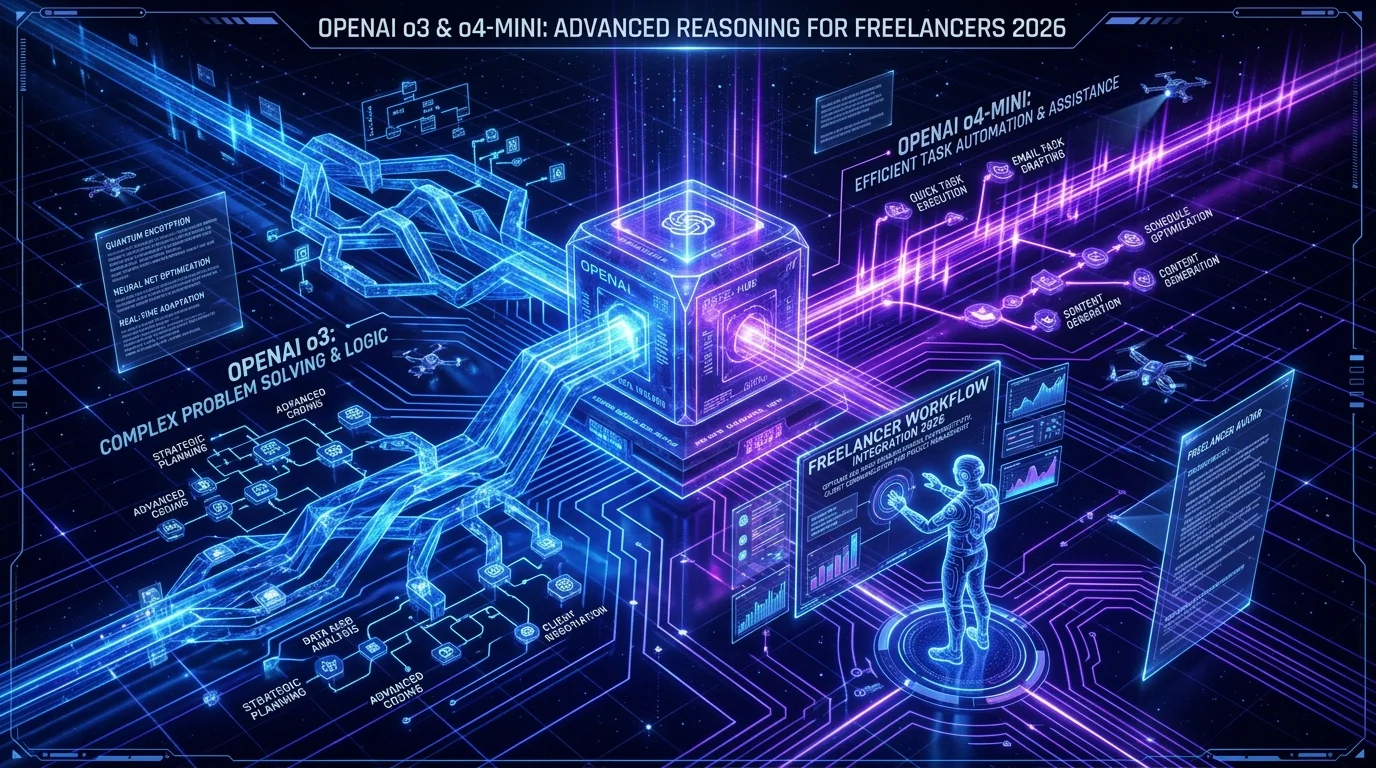
o3 is OpenAI's flagship reasoning model, scoring at a level that surpasses human experts on several competitive benchmarks including AMC mathematics, AIME qualifying exams, and the SWE-Bench software engineering test. It can solve programming challenges, debug complex code bases, and handle multi-step analytical tasks with a reliability that earlier models couldn't match. For freelancers, o3 is the model to reach for when you're genuinely stuck — when you need a difficult piece of logic explained perfectly, when a client's brief has conflicting requirements you need untangled, or when you need airtight reasoning in a report or white paper. o3 is available within ChatGPT Plus and Team subscriptions and through the OpenAI API.
o4-Mini: More Affordable Reasoning
o4-Mini delivers most of o3's reasoning capability at a fraction of the API cost and with significantly faster response times. OpenAI's own evaluations showed o4-Mini matching or exceeding o3 on coding and math benchmarks despite being a smaller model, thanks to targeted training improvements. For freelancers on a budget, o4-Mini is the practical choice: you get noticeably smarter responses than GPT-4o for tasks requiring careful reasoning, without the higher cost and slower speed of full o3. It's available in ChatGPT Plus and is very affordable via the API at $1.10/$4.40 per million input/output tokens.
o3 vs o4-Mini vs GPT-4o: When to Use Each
GPT-4o remains the fastest and most versatile model for everyday tasks. If you're drafting an email, summarising a document, generating social media copy, or asking a quick research question, GPT-4o is the right default — it's responsive, handles images and files, browses the web in real time, and costs less thinking time for simple requests. Switch to o4-Mini when you're writing code that needs to be bug-free, crafting a complex argument in a proposal, or analysing data where logical accuracy matters. Use o3 for your most demanding tasks: reviewing an entire codebase for security vulnerabilities, building a multi-step financial model explanation, producing a structured research report with airtight citations, or any task where you genuinely can't afford an error.
5 Practical Use Cases for o3 & o4-Mini
1. Debugging and code review. When GitHub Copilot or GPT-4o gives you a solution that "almost works," paste the problematic code into o3 and ask it to reason through every potential failure case. It will often catch the subtle bug that other models missed.
2. Contract and proposal analysis. When a client sends a complex contract with conflicting clauses, o3's reasoning capabilities help it identify inconsistencies, flag unfavourable terms, and produce a clear risk summary — tasks requiring careful cross-referencing that standard models often get wrong.
3. Research-backed writing. Ask o4-Mini to construct a structured argument for a white paper or thought leadership article. The chain-of-thought reasoning produces logical flow and coherent argumentative structure that GPT-4o occasionally loses track of in long documents.
4. Complex client briefs. When a client brief has multiple conflicting requirements ("edgy but professional, minimalist but feature-rich"), o3 can walk through each requirement, identify the tensions, and propose a creative direction that genuinely reconciles them rather than just defaulting to one interpretation.
5. Data and financial analysis. Give o4-Mini a messy data set or financial spreadsheet and ask for an analysis with recommendations. The multi-step reasoning capability produces analysis that identifies non-obvious patterns and produces logical, justified conclusions rather than superficial summaries.
Limitations to Know
The o-series models are slower than GPT-4o — they take time to "think," which can feel frustrating for quick tasks. They are also more expensive per query, especially o3, which means running every prompt through o3 is neither practical nor cost-effective. They are best used selectively, for the tasks where reasoning quality genuinely matters. Additionally, o3 and o4-Mini don't yet support all the multimodal features of GPT-4o in all contexts — for generating DALL-E images or running Code Interpreter in an interactive session, GPT-4o remains the better interface. The models also have a knowledge cutoff and depend on web browsing for current information, just like other ChatGPT models.
Pricing
ChatGPT Plus ($20/month) gives you access to all three: GPT-4o, o4-Mini, and o3, with usage limits on o3. For API access: o3 is $10/$40 per million input/output tokens; o4-Mini is $1.10/$4.40 — making o4-Mini extremely affordable to integrate into custom tools and workflows. The gap in cost between o4-Mini and premium models like GPT-4o Turbo has narrowed considerably, making o4-Mini a default for developers building reliability-critical applications.
Verdict
The o-series models represent the most significant practical improvement in AI capability available to freelancers. Not because they're faster or cheaper — they're neither — but because they make substantially fewer logical errors on difficult tasks. For most routine freelance use, GPT-4o is sufficient. For the tasks where you absolutely need to get it right — complex code, nuanced strategy, airtight analysis — o3 and o4-Mini are now essential tools in any serious freelancer's toolkit.
Get Our Free AI Tools Guide
Join 50k+ freelancers getting weekly AI tips and tool reviews.
Explore Prompt Library →