A Navier-Stokes Credit Fight, Meta's Agent Goes Live, and Google Bets on Finnish Nuclear
⚡ Quick Summary
- ✓ Millennium Prize Controversy: OpenAI claims 10,000 AI agents solved a Navier-Stokes singularity proof in Lean, sparking a priority dispute with academic researchers.
- ✓ Meta Muse Agent Live: Meta launches "Muse" in the U.S., a personal AI agent running inside secure virtual machines to manage email, travel, and checkout operations.
- ✓ Geopolitical Distillation Advisory: NSA, CISA, and FBI accuse 6 leading Chinese AI labs of systematic model distillation targeting U.S. frontier models.
- ✓ Google Finnish Nuclear Deal: Google commits $15B to Finnish AI data centers and signs a 22-year nuclear power contract with the Loviisa plant.
- ✓ Mega Funding & Bio-AI: Cognition valuation reaches $48B, Harvey hits $15.6B, and Google DeepMind releases the petabyte-scale AlphaGenome Atlas.
Two days after Claude helped formalize a landmark fluid-dynamics result, the same corner of mathematics is now at the center of a credit dispute — while consumer AI agents take a real step toward handling people's inboxes and wallets, and the AI infrastructure race extends into national power grids.
OpenAI claims a Millennium Prize result — and immediately faces a credit dispute
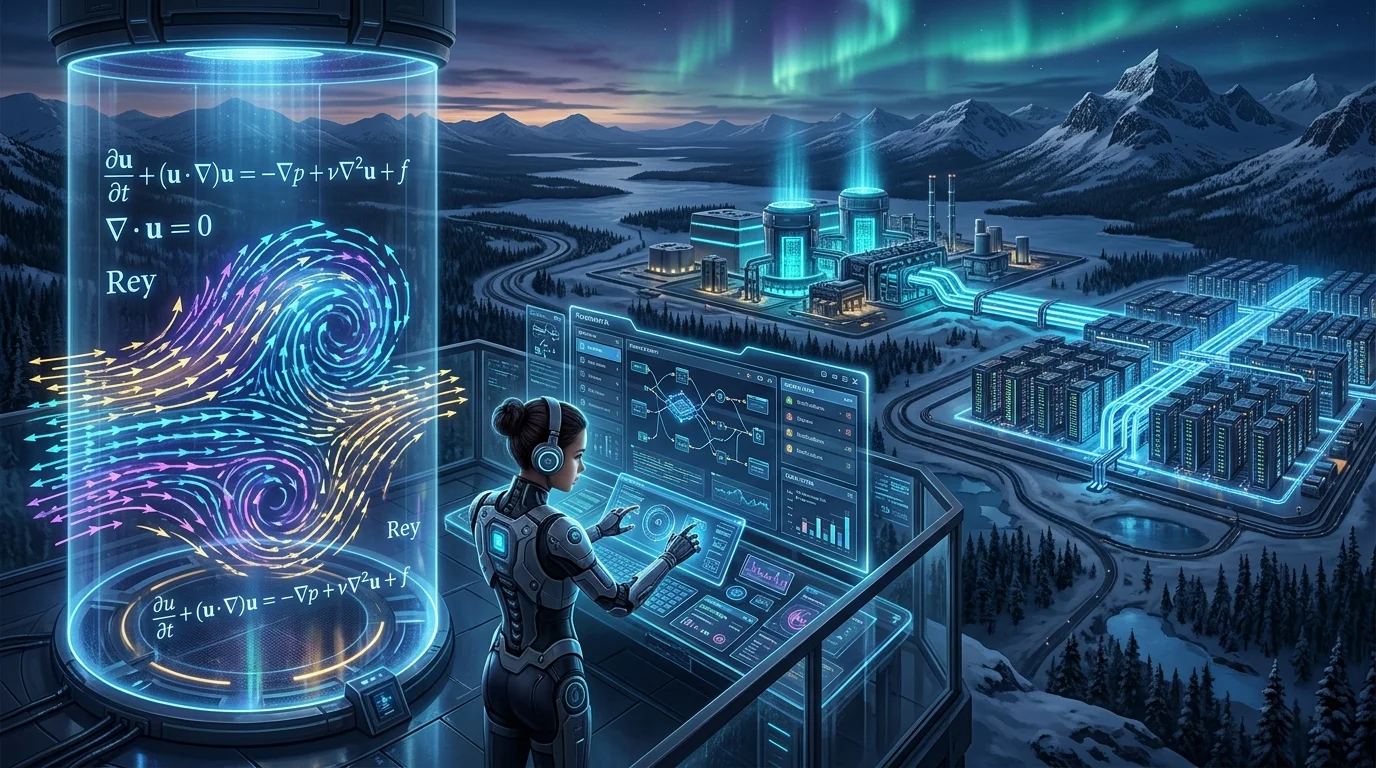
OpenAI says an internal, more capable successor to GPT-6 Astra coordinated roughly 10,000 AI agents over 88 hours to produce an analytical proof that a three-dimensional fluid governed by the Navier-Stokes equations can develop a singularity in finite time — a partial resolution touching one of math's seven Millennium Prize Problems, backed by a Lean-formalized proof.
The announcement immediately ran into controversy: NYU mathematician Tristan Buckmaster, who published a related blowup result for the Euler equations earlier this month with Anthropic researcher Levent Alpöge and Claude's help, has questioned whether OpenAI accelerated its own effort after learning of their unpublished progress. OpenAI denies any improper access to that work, while acknowledging that de-identified product data may have indirectly informed its models.
Independent mathematicians will need time to verify the proof either way — but the dispute itself says something new: for the first time, rival AI labs are fighting over research priority the way academic labs have fought over discoveries for centuries.
Meta's Muse steps into your inbox
Meta rolled out Muse, a personal AI agent, to U.S. adults this week — capable of managing schedules, drafting and sending email, booking travel, comparing prices, shopping, and filling out forms across connected services including Google Workspace, Ticketmaster, OpenTable, and Apple Health, with purchases running through Stripe's Link checkout.
It's the most concrete consumer product yet from Mark Zuckerberg's "personal superintelligence" push, arriving inside a dedicated secure virtual machine with its own browser, and priced with a free tier alongside $20 and $100 monthly plans.
The launch lands awkwardly close to Meta's $18 billion multistate settlement over social-media harms, and Reuters has reported internal concern about the agent mishandling sensitive personal data — a real test of whether people are ready to hand an AI system the keys to their email and payment methods.
Washington accuses six Chinese labs of mass model distillation
The NSA, CISA, and FBI issued a joint advisory on September 8 alleging that DeepSeek, Moonshot AI, Alibaba, MiniMax, StepFun, and Z.AI have run coordinated, large-scale distillation campaigns against U.S. frontier models since late 2024 — extracting billions of tokens across millions of exchanges to train competing systems more cheaply.
It's the most direct government accusation yet of systematic model theft-by-distillation, and it lands the same week China's own regulators are separately pushing back on U.S. pressure over AI alignment, keeping the "pick a side" tension from earlier this month very much alive.
Google locks in nuclear power for the AI buildout
Google committed roughly $15 billion to AI infrastructure and energy projects in Finland through 2027–2028, including a 22-year deal to buy up to half the output of the Loviisa nuclear plant from 2030 to 2049.
It's a clear signal that the constraint on the next phase of AI growth is shifting from chip supply toward electricity supply — hyperscalers are now willing to sign multi-decade nuclear power contracts just to guarantee the grid capacity their data centers will need.
Mega-rounds, AlphaGenome, and 10-hour network intrusions
Also today: Cognition, maker of the autonomous coding agent Devin, raised more than $2 billion at a $48 billion valuation — nearly double its valuation from May — while legal AI startup Harvey closed a $550 million round at $15.6 billion, more than triple its valuation from March.
Google DeepMind released AlphaGenome Atlas, a free, petabyte-scale dataset predicting the molecular effects of all 9 billion possible single-letter human DNA variants. And Palo Alto Networks' Unit 42 documented an AI-agent-driven enterprise network intrusion completed in under 10 hours — work Unit 42 estimates would have taken a human team roughly two weeks.
The bigger picture
Barely a week after formal mathematics and formal safety thresholds both became live stories, the frontier keeps producing genuine breakthroughs and genuine new anxieties in the same news cycle — sometimes, as with today's Navier-Stokes dispute, in the very same story.
Written by Best AI Tool Editorial Team
We test, review, and curate the best AI tools, models, and industry updates for freelancers, developers, and creators.