OpenAI Agents SDK Update: What Freelancers Building AI Workflows Need to Know
Quick Summary
- OpenAI's updated Agents SDK adds a more capable agent harness for long-running work across files, tools, and systems.
- It now supports native sandbox execution so agents can safely read files, run commands, install dependencies, and write outputs.
- The SDK supports primitives freelancers increasingly care about: MCP, skills, AGENTS.md, shell tooling, and patch-based file edits.
- Python support is live now, with TypeScript support planned next.
- This matters most if you build research agents, internal automation, coding assistants, or client-facing workflow tools.
OpenAI's latest Agents SDK update is one of the more practical AI announcements for freelancers this month. It is not another model launch. It is infrastructure for actually building dependable agents that can inspect files, use tools, execute code inside a controlled workspace, and keep going across long tasks. If you have been experimenting with AI agents but still stitching together brittle scripts, this update is more relevant than most headline model releases.
What shipped in the new Agents SDK
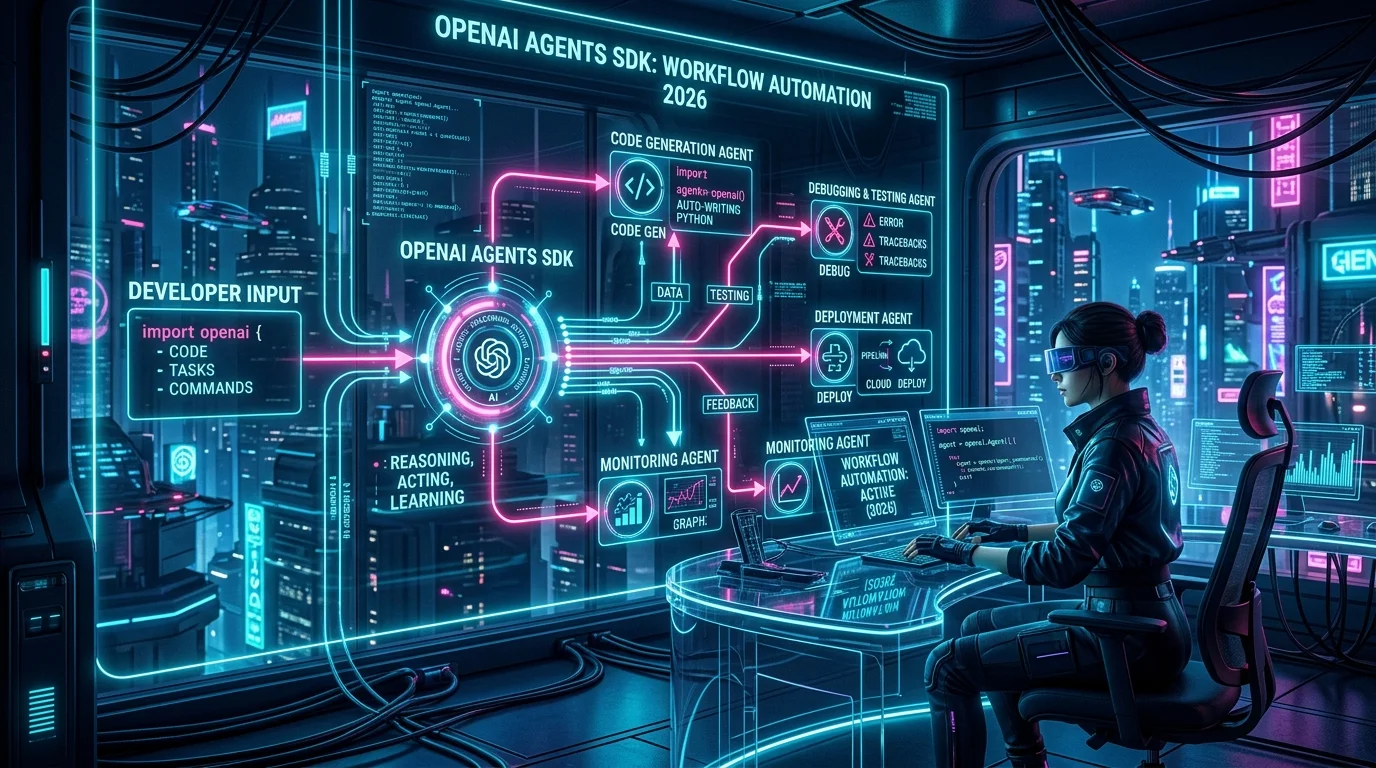
OpenAI says the SDK now includes a stronger harness for the agent loop, plus native sandbox execution. In practice, that means developers can give an agent a workspace with files, tools, and explicit instructions, then let it reason through a task without bolting together half a dozen external components. The SDK also supports patterns that are becoming standard in agent systems: MCP integrations, AGENTS.md instructions, skills, shell execution, and file editing flows.
Why this is different from a basic chatbot wrapper
Most agent demos break when the work gets real. They lose context, fail on file handling, or need too much manual orchestration. OpenAI's update is trying to solve that gap. The harness is built to handle files, tools, memory, and longer-running execution in a way that stays closer to how frontier models actually perform best. For a freelancer, that matters because the difference between a toy automation and a reusable service is usually infrastructure, not prompting.
Best freelance use cases right now
Research and audit agents. Build an agent that reads a folder of client docs, compares claims, extracts key facts, and writes a summary or checklist.
Codebase assistants. Build an agent that inspects a repository, identifies a bug, edits files, and prepares a clean implementation draft inside a sandbox.
Ops and process automation. Turn scattered notes, spreadsheets, or support transcripts into briefs, SOPs, action lists, and follow-up emails.
Internal tools for retainers. Productize services like SEO assistants, content QA agents, or proposal prep tools.
Why the sandbox piece matters
OpenAI is explicitly framing separation between harness and compute as a security and durability feature. Prompt injection and data exfiltration are not theoretical problems once agents can access tools and files. Native sandbox execution gives you a safer default, and the Manifest abstraction makes it easier to define exactly what data the agent can access. If you work with client files, contracts, or sensitive repositories, this is the feature to pay attention to first.
What the update does not solve
This does not remove the need for careful scope control, evaluation, or human review. Agents still need guardrails. They can still misuse tools, overrun costs, or produce confident but flawed outputs. And if you work mainly in JavaScript, the current Python-first rollout means you may need to wait for first-party TypeScript support or build around the gap. The SDK makes agents more practical, not automatic.
How freelancers should use it this month
Start small. Pick one workflow that already has clear inputs and outputs. A good example is a client research brief agent that reads a data room, surfaces the top findings, and generates a structured draft. Another is a repository assistant that writes implementation notes and a patch proposal for bugs. The win is not building the flashiest agent. It is building one workflow that saves you hours every week and can be repeated safely.
Verdict
For freelancers, the Agents SDK update is important because it moves agent building a little closer to real production work. If you sell automation, research, technical implementation, or internal tooling, this is worth experimenting with now. If you only use AI for chat and copy generation, it is less urgent. The main shift is simple: the market is moving from single prompts to tool-using workflows, and this update is part of that transition.
Get Our Free AI Tools Guide
Join freelancers getting weekly AI tips, workflows, and tool reviews.
Explore Prompt Library →