How Freelance Copywriters Are Using AI Without Losing Their Clients
⚡ Quick Summary
- • Most clients either don't know or don't care whether AI was involved in copy
- • AI excels at research, first drafts, and structural outlines — not at brand voice
- • The copywriter's job shifts from writing to directing, editing, and brand stewardship
- • Transparent ("AI-assisted") and non-transparent approaches both work commercially
- • AI users producing the same output in less time charge the same rates — they pocket the difference
The Copywriter's AI Dilemma
Of all the freelance professions disrupted by AI, copywriting sits at the sharpest edge. Language models do exactly what copywriters do: produce words that communicate ideas persuasively. This has created a genuine existential anxiety in the copywriting community — but the reality playing out in the market is more nuanced. The copywriters who are thriving in 2026 have not abandoned AI, and they haven't been replaced by it. They've assimilated it into their process in ways that make them dramatically more productive while maintaining what clients actually pay for: strategic thinking, brand understanding, and distinctive voice.
What Clients Think About AI
Client attitudes toward AI in copywriting are more varied than copywriters assume. Research consistently shows that clients care about three things: the copy works (drives conversions, matches brand voice, achieves the strategic goal), the process is professional, and they receive good value. Most clients are indifferent to the method unless they have an explicit policy against AI-generated content (some regulated industries and publications do). The fear that clients will reject AI-assisted work is largely unfounded — provided the quality meets expectations. Clients who do ask directly about AI deserve an honest answer, which brings us to the question of transparency.
Where AI Helps Copywriters
The tasks where AI genuinely transforms copywriter productivity: Research and competitive analysis (summarising industry reports, identifying competitor messaging); First draft generation (producing a workable structure to refine, rather than a blank page); Variant generation (producing 10 headline options, 5 CTA variations, multiple subject line tests); SEO integration (identifying keyword opportunities and integrating them naturally into existing drafts); Editing passes (Grammarly and Claude for tone adjustment, clarity, and concision); and Translation preparation (producing draft translations that professional translators review). These tasks collectively represent 40–60% of typical copywriting project time.
Where AI Falls Short
AI consistently underperforms in tasks requiring: genuine brand voice (AI produces generic professional tone by default, not the specific personality that makes a brand distinctive); deep understanding of a specific audience's unspoken concerns; creative leaps that feel unexpected and memorable; knowledge of what a client has said in previous campaigns; and nuanced emotional intelligence about when to be direct, subtle, irreverent, or formal. These are precisely the capabilities that make an experienced copywriter worth $150–$300/hour rather than $50 — and AI has not materially eroded the premium for these skills.
The AI-Augmented Copy Process
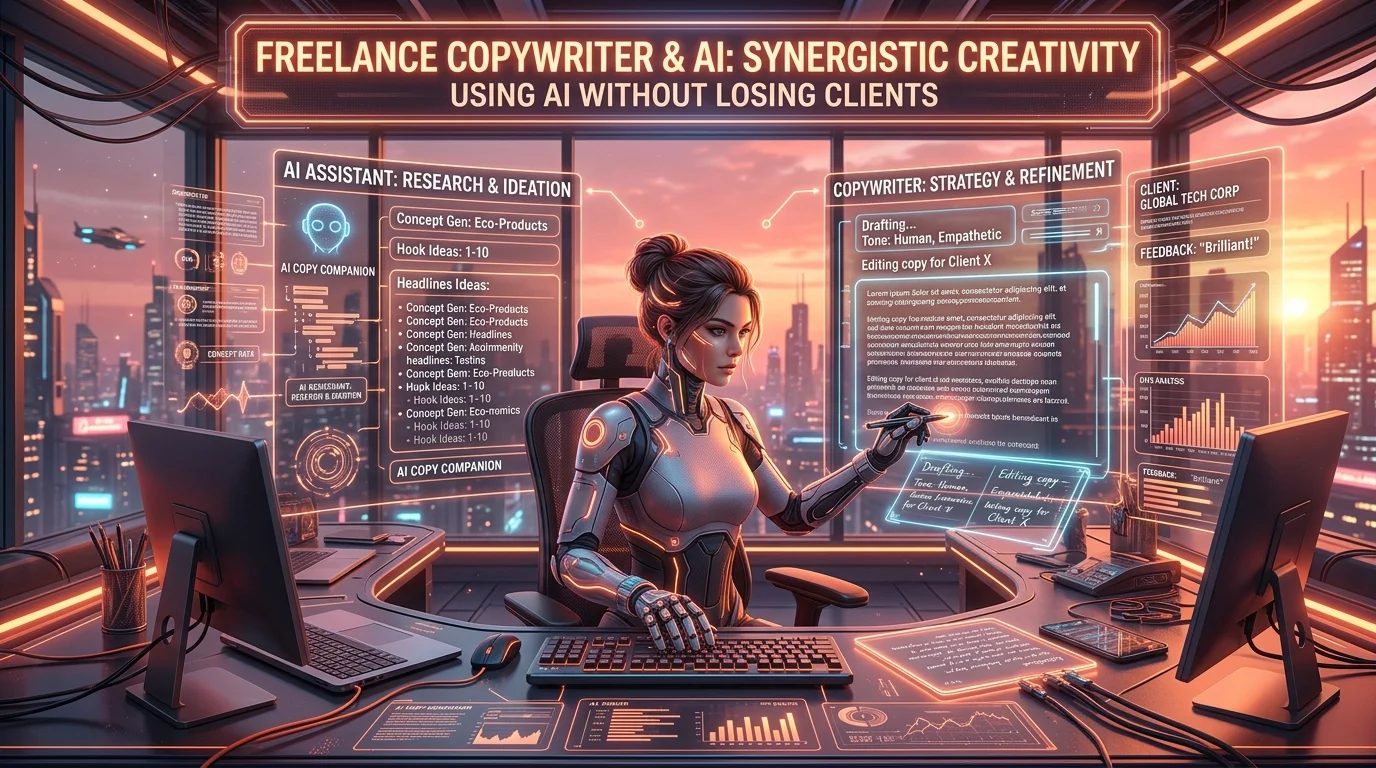
The workflow that high-performing copywriters are using in 2026: Use Perplexity AI for competitive and audience research (30 minutes instead of 3 hours). Feed the research plus client brief to ChatGPT for a structural outline. Generate a first draft with AI, focusing on structure and completeness rather than voice. Apply your brand voice, strategic insight, and editorial judgment in editing (this is the irreplaceable step). Use Grammarly or Claude for a final polish pass. The result is output that takes 40–50% less clock time but delivers the same or better strategic quality — because the copywriter's cognitive effort is concentrated on the high-value work instead of diluted across mechanical tasks.
How to Talk to Clients About AI
If clients ask whether you use AI, the most professional response is honest and confident: "I use AI tools the same way I use Grammarly or research databases — as part of my professional toolkit. Every piece of copy I deliver represents my strategic thinking, brand judgment, and editorial standards. AI helps me work more efficiently so I can invest more cognitive effort in the strategic and creative work that actually moves the needle for your business." This framing is accurate, professional, and positions AI as a sign of capability rather than a shortcut.
Pricing When Using AI
The pricing debate in copywriting circles around AI is fierce but ultimately misses the point. Clients pay for outcomes, not hours. If you were previously charging $500 for a landing page that took 8 hours to write, and now it takes 4 hours, you have two options: keep the $500 rate (your effective hourly rate doubles) or reduce to $350 and win more clients on value. Neither is wrong — it depends on your market position and growth goals. What you should not do is reduce prices to compete with $10 AI-generated copy, because that race has a floor that no human copywriter should try to match.
Staying Ahead
The copywriters who will thrive long-term are those who develop skills that compound AI capability rather than compete with it: brand strategy, conversion optimisation expertise, customer research methodology, and specialised industry knowledge. A copywriter who understands SaaS onboarding psychology, or the regulatory language of financial services, or the specific tone that works for luxury consumer brands — and who uses AI to execute their strategic direction efficiently — is more valuable in 2026 than a technically proficient writer who ignores these tools.
Get Our Free AI Tools Guide
Join 50k+ freelancers getting weekly AI tips and tool reviews.
Explore Prompt Library →