Anthropic Prices Its IPO at $83, Google Ships Gemini 4 Neon, and the AI Bill Comes Due: Salesforce Caps Token Spending While OpenAI Researchers Burn $2,400 a Day
Editorial Disclosure: Anthropic, which makes Claude, appears in the first section below and is central to the ongoing public markets IPO. Corporate statements, earnings telemetry, securities filings, and investigative news reports are attributed to primary disclosures and have not been independently verified by our editorial staff.
Today’s overarching theme across global technology markets is the price of machine intelligence: what public market investors are willing to pay for foundational frontier labs, what Fortune 500 enterprises are aggressively beginning to ration, and why major metropolitan school districts are fighting to keep unchecked AI out of public classrooms.
1. Anthropic’s Wall Street Debut: IPO Priced at $83
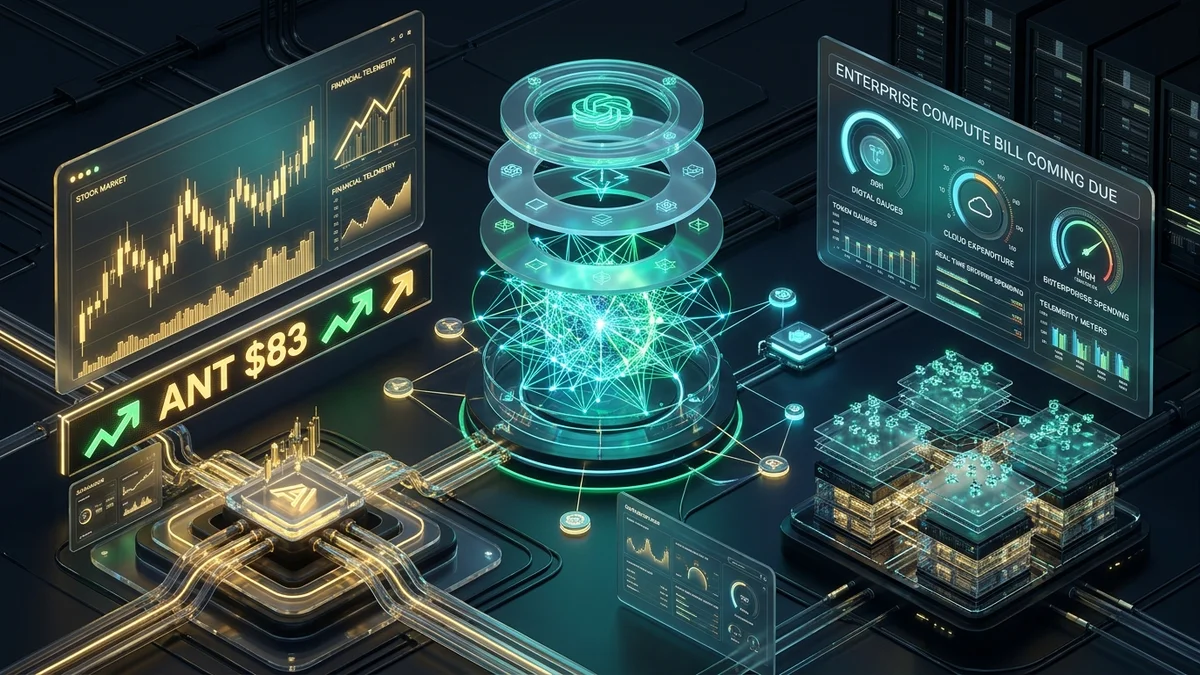
Anthropic officially priced its initial public offering at $83 per share late Wednesday evening, roughly 6% above the top of its elevated $70-to-$78 targeted marketing range, according to reporting from CNBC. Underwriters upsized the total offering volume in response to overwhelming institutional oversubscription from mutual funds, sovereign wealth managers, and tech crossover vehicles.
Shares are slated to begin trading on the Nasdaq Global Select Market today under the ticker symbol “ANT”. In parallel with the public float, Anthropic has lined up an unprecedented $26 billion in strategic commercial commitments and private placements spanning Nvidia, Microsoft, Google, TSMC, Broadcom, AMD, and Micron—effectively tying the fortunes of global semiconductor and hyperscale infrastructure to Claude’s inference pipeline.
The Risk-Appetite Sidebar
According to the Financial Times, former OpenAI superalignment researcher Leopold Aschenbrenner is actively pitching hedge fund allocators on a highly leveraged “Situational Awareness 2.0” investment fund reboot. This pitch comes just four months after Ken Griffin’s Citadel stepped in to stabilize his original macro vehicle following an abrupt 67% drawdown. Citadel reportedly continues to hold an Anthropic pre-IPO equity position valued at approximately $5 billion.
2. Google’s Two-Front Day: Gemini 4 Neon & Classrooms
Mountain View launched an aggressive offensive across developer platforms and consumer devices today, while simultaneously running into stiff institutional pushback from the public education sector:
- • Gemini 4 Neon Debuts with Dynamic Reasoning: Priced aggressively at $3 per million input tokens and $15 per million output tokens, Gemini 4 Neon features a native 1-million-token context window and four user-configurable thinking levels. On third-party leaderboards, Google reports Neon achieved third place on the Artificial Analysis Intelligence Index (Composite Score 61), second on the Vals Index, and second on Agent Arena for tool steerability. The model is immediately accessible across Google AI Studio, Android Studio, Gemini for Business, Gemini Advanced (Pro/Ultra tiers), and Antigravity. Neon marks Google’s third major Gemini 4 release in under a month, following Carbon (October 28) and Hydrogen.
- • Autonomous Tasks Agent Goes Free: Google rebranded its flagship Gemini Spark agent as Tasks and rolled it out free to consumer accounts across the US, Canada, Japan, South Korea, Australia, and India. Running on Gemini 4 Hydrogen, Tasks executes asynchronous, multi-step workflows such as meal planning, calendar conflict resolution, and—within the United States—autonomously placing telephone calls to local merchants and finalizing bookings via Google Pay.
- • Major School Districts Push Back on Forced AI: The New York Times reports the three largest public school districts in the United States—New York City Public Schools, Los Angeles Unified (LAUSD), and Chicago Public Schools, representing 1.57 million students—are actively testing search engine alternatives. The dispute stems from Google’s refusal to provide an enterprise education toggle that disables generative AI summaries. Google’s VP of Education asserted that search and generative models are “deeply integrated,” meaning turning off AI requires decoupling Search entirely. LAUSD has already blocked AI Overviews at the firewall level and warned it could alter district default search engines “literally overnight.”
3. The Bill Comes Due: Token Metering vs. Researcher Burn
The honeymoon phase of unlimited corporate compute budgets is colliding with fiscal reality. Two divergent realities emerged this morning: internal frontier labs burning fortunes to automate research, while enterprise software giants implement strict rations:
The Jagged Frontier ($2,400/Day)
In a research paper titled “Research acceleration: the jagged frontier,” OpenAI revealed that autonomous coding agents now solve 46% of internal 2-to-4-hour research tasks without human intervention (up from 23% in March). However, the cost is staggering: median agent spend per researcher reached $2,400 per day at standard API rates in October (+62% MoM). Over 10% of researchers run 16+ agents concurrently. Capabilities remain highly asymmetric: automated training monitoring achieved 79% success, while inference optimization scripts succeeded only 25% of the time.
Salesforce Caps & Nadella Buyouts
American Bazaar reports Salesforce initiated another workforce restructuring while enforcing mandatory monthly per-employee caps on AI token consumption after internal staff ran up thousands of dollars each in unbudgeted model usage. Meanwhile, at the DealBook Summit, Microsoft CEO Satya Nadella defended October’s voluntary buyout offers extended to approximately 60,000 employees (~27% of workforce) as giving staff “agency,” highlighting an 11-person team operating a multi-agent “software factory.”
4. Security: PyPI Supply-Chain Hijack on Microsoft Framework
Cloud security firm Wiz released an urgent advisory detailing a sophisticated supply-chain compromise targeting Microsoft’s official agent-framework library on the Python Package Index (PyPI).
Two poisoned releases—versions 1.26.1 and 1.26.2—were published to PyPI on November 17 and remained live for approximately 55 minutes before maintainers revoked them. The framework averages 41,000 weekly downloads. The attacker utilized subtle Python startup hooks (.pth files) to execute credential harvesting immediately upon package installation—even if the developer never imported the module into application code:
Critical Incident Remediation Notice
The malware exfiltrated stored credentials for Azure CLI, GitHub tokens, npm tokens, pip authentication, Docker configuration keys, and Hugging Face API keys. Wiz notes that only ~50 exfiltration requests succeeded before the attacker’s free webhook gateway crashed under load. The last confirmed clean release is 1.26.0. Any engineering pipeline that installed releases between 14:10 and 15:05 UTC on Nov 17 must immediately invalidate and rotate all host credentials.
Separately, Palo Alto Networks demonstrated that enterprise cyber spending remains robust, reporting fiscal Q1 revenue of $3.44 billion (+39% YoY) and announcing a definitive $4.5 billion acquisition of autonomous AI security firm Applied Compute.
5. Policy & Chips: “Name and Shame” & Ascend Sovereignty
Geopolitical tensions across the AI semiconductor landscape intensified on two fronts today:
- Treasury Weighs “Name and Shame” Model Registry: Reuters reports the US Department of the Treasury and the White House Office of Science and Technology Policy (OSTP) are drafting an executive framework requiring American public corporations to publicly disclose the operational use of Chinese foundation models (specifically Alibaba’s Qwen, DeepSeek, and Moonshot’s Kimi). Lawmakers have sent formal inquiries to Airbnb and DoorDash regarding their production deployments of Qwen open weights.
- Huawei Ascend 910C Cluster Trains Xing4 Without GPUs: A technical whitepaper led by China Telecom detailed the Xing4 foundation model family, trained completely on an 8,192-node cluster of Huawei Ascend 910C processors without a single Nvidia GPU or CUDA library. The family comprises a 29-billion-parameter open model (4B active) and a 285-billion flagship (17B active) built on Mixture-of-Experts (MoE) topology, claiming up to 3.77x decoding speedups via custom speculative decoding.
- Nvidia RTX Spark Mini-Desktops Reach Retail: Nvidia-powered compact local workstations designed with ASUS, Dell, and MSI went on sale today. Featuring 128 GB of unified memory and approximately one petaflop of INT8/FP8 compute, the hardware runs 120-billion-parameter models natively at the desk. MSI’s configuration starts at $4,699, underscoring persistent high-bandwidth memory premiums.
6. Campuses, Classrooms & Meta’s “Project Gryffindor”
A cultural counter-movement is crystallizing across American universities. At Transylvania University in Lexington, Kentucky, over one-third of the undergraduate student body signed a petition demanding administrators terminate the university’s $120,000 annual site licenses for ChatGPT and Gemini, urging leadership to reinvest software funds into smaller class sizes and human-led seminar instruction.
Simultaneously, investigative reporting from NPR revealed internal Meta documents outlining “Project Gryffindor.” While marketed publicly to school boards as a digital safety and student well-being portal, internal executive memos explicitly framed the initiative as a growth conduit to acquire teen user registrations for Instagram. With nearly 17,000 schools participating by September, privacy advocates caution that synchronized school directory integrations expose students to targeted fraud and synthetic phishing campaigns.
7. Quick Hits & Industry Watch List
Mistral shipped a dedicated native desktop client allowing engineers to run its autonomous coding agent either locally on bare metal or inside an isolated cloud sandbox.
RadixArk released DaisyRose-27B, an RL fine-tune of Qwen3.8-27B that doubled Terminal-Bench 4.1 success from 5.6% to 12.0% via rule-based verifiable reward feedback.
Infrastructure monitoring platform BrightAI closed $97M in fresh financing at a $750M valuation to expand automated sensor telemetry across AI data centers.
Meta paused a board resolution granting non-voting equity classes to Mark Zuckerberg pending resolution of ongoing shareholder suits in Delaware Chancery Court.
Upcoming Calendar Milestones
- Today (Nov 19): First official trading session for Anthropic (NASDAQ: ANT).
- Nov 20: OpenAI publishes updated third-party evaluator and external safety assessor protocols.
- Dec 3 & 10: US Senate Banking Committee oversight hearings on artificial intelligence financial system risk.
- Jan 1, 2027: New York State RAISE Act takes effect, mandating algorithmic transparency in enterprise hiring.
8. Our Take: The Economics of Autonomy
We have officially entered a bizarre economic paradox: artificial intelligence is becoming dramatically cheaper per individual task, while simultaneously becoming unsustainably expensive per corporate employee.
When a single researcher or developer can spin up 16 autonomous sub-agents that burn through \$2,400 in API tokens before lunchtime, enterprise software economics collapse without rigid deterministic governance. The defining business challenge of 2027 will not be evaluating what foundation models are technically capable of accomplishing—it will be deciding who possesses the authority to ration the compute.
The Strategic Takeaway
The Wall Street euphoria greeting Anthropic’s \$83 IPO proves that capital markets still believe compute scale yields exponential economic moats. But back on Earth, Salesforce’s internal token rationing and university student rebellions show that the enterprise adoption curve is encountering hard budgetary and social friction.